Showing posts with label Books on Journalism. Show all posts

Feb 27, 2024

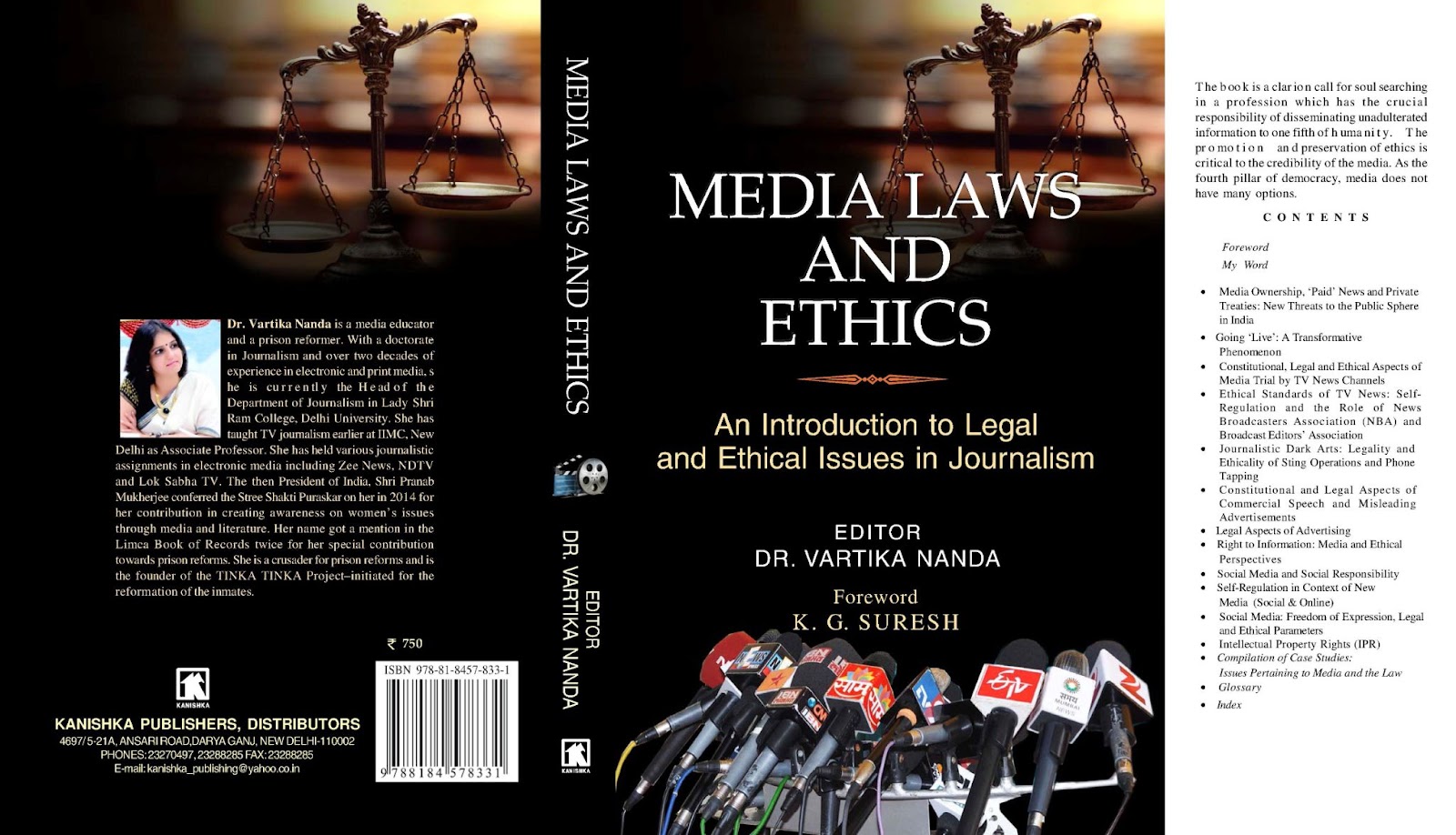
MEDIA LAWS AND ETHICS: An Introduction to Legal and Ethical Issues in Journalism: Editor: Dr.Vartika Nanda


Title: Media Laws and Ethics: An Introduction to Legal and Ethical Issues in Journalism

Author: Dr. Vartika Nanda

Publisher: Kanishka Publishers 

Year: 2018

Genre: Journalism and Media Studies


‘Media Laws and Ethics: An Introduction to Legal and Ethical Issues in Journalism’ is an academic work in the field of mass communication and media studies. Edited by Dr. Vartika Nanda, this book was published in 2018 by Kanishka Publishers. The book comprises twelve chapters that provide an in-depth knowledge of the concepts and issues surrounding laws and ethics in journalism. Fourteen academicians, journalists and media educators have contributed to this insightful piece of work to provide a better understanding of some of the important ethical concerns and legislative structures circling the media. The book explores in detail the concepts like paid news, relentless misuse of social media and media trials, that run parallel to the trials by the court. It, moreover, makes the students of journalism and media professionals  aware of their legal and social responsibilities alongside exploring crucial  topics  of public interest like media laws and the provisions in the Constitution of India pertaining to media, in detail.


IMPORTANCE IN THE CURRICULUM OF JOURNALISM


Media laws and ethics is an integral part of media studies in semester III, in the course of BA (Hons) Journalism in the University of Delhi. This book has also been suggested as a reading in the Indian Institute of Mass Communication (IIMC). It is studied as a part of the syllabus in several other universities that offer the course in journalism and media studies. Study of journalism is rather incomplete without the study of the laws, rules and ethics encircling media. This book serves as an important source of information for the students when they prepare for their exams. Students often refer to it as a resource to conduct detailed research on various topics under the curriculum of Media Laws and Ethics. It also serves as an academically acclaimed piece of work that facilitates the journalistic skills of the students as they prepare to work in the professional sphere.


FOREWORD BY K. G. SURESH Professionalism is fine but does it justify a missionary turning into a mercenary? asks K.G. Suresh, the Director General of the Indian Institute of Mass Communication (now Vice Chancellor of Makhan Lal Chaturvedi University, Bhopal, Madhya Pradesh), while writing the foreword for this book. He traces the onset of journalism in India as a noble profession and talks critically of the practices of paid news, advertorials and private treaties that often hinder the ethical practice of journalism today. While writing about the freedom of speech and expression in journalistic terms, K. G. Suresh says, Freedom has been turned into a license. Legitimate questions are being labeled as blatant violation of a freedom sans reasonable restrictions or accountability. He raises necessary questions about some of the very prevalent practices in Indian journalism that are weakening its roots, like that of fake news, aggressive reporting and the lack of sober and soft-spoken language in the domain of news reporting.


FOREWORD BY DR. VARTIKA NANDA


Dr. Vartika Nanda has explained the impact and intensity of media trials through one of the very prominent case studies, namely, that of the ‘Aarushi Talwar murder case’. This case rose to fame because of the relentless trails run by the media parallel to the trial by the court. Dr. Vartika Nanda interviewed Nupur Talwar in the jail in October 2015. This interview was released in October 2017, and was the first and the last interview recorded inside the jail. 

Suggested videos: 

https://youtu.be/7PpWkaCGNh0 


Amidst the debate of who killed Aarushi, one question neglected all along was: how would Talwar couple eventually get themselves accepted in the society. Stating this, she raises a very prominent concern about how media trials permanently tarnish the reputation of the parties involved, with  irresponsible reporting based on no legal or legislative understanding of a particular case. She also calls attention to the prevalence of sensationalism in journalism through this book. Talking about sensationalism, she mentions that the  players change, but the elements of drama, tamasha and entertainment remain.  


CHAPTERS


Opening chapter of this book dwells deep into the subject of media ownership and covers topics of paid news and private treaties. In this chapter, Keval J. Kumar talks about the new media as a public sphere. He describes how new media transforms into the Fourth Estate and depends on other ‘societies’ to be viable or profitable.  In the second chapter, Professor Archana R. Singh explains  the concept of live reporting of news along with its historical background and scope in future. Third chapter studies the constitutional, legal and ethical aspects pertaining to media trials by television channels. It has been penned down by Dr. Susmita Bala. Ethical standards of television news reporting and the role of News Broadcasting Association (NBA) have been researched upon thoroughly in chapter four of this book. This chapter has been written by Hemant Kaushik,  a television journalist.


In this series, the chapter on legality and ethicality of sting operations and phone tapping, describes how the practice is considered as ‘journalistic dark acts’. Charu Chandra Pathak, who is a media educator and an independent documentary filmmaker has put this chapter in black and white. The sixth chapter written by Dr. Ambrish Saxena, and the seventh chapter written by Dr. Arvind Kumar, deals with the constitutional and legal aspects of commercial speech and advertising, respectively.

Right To Information (RTI) has been talked about by Albert Abraham, in respect to media and ethical perspectives in chapter eight of this book. The next chapter has been written by Nawal Kishor on the social responsibility circling the use of social media, followed by a chapter consisting of a detailed study of self regulation in context of new media, which has been put in writing by Dr. Amit Nagpal. The eleventh chapter dives further deep in the study of social media and the practice of freedom of expression as well as its legal and ethical parameters. It has been written by Dr. Rachna Sharma. Chapter twelve is about intellectual property rights. This chapter has been written by Dr. Archana where she draws the lines of the history of the Intellectual Property Rights in India. She highlights that the laws were there but were not enough to protect the intellectual property rights of the people because the government and the people had not thought to protect their ancient knowledge by any specific law. 


STUDENT ENGAGEMENT 


These twelve chapters are succeeded by a critical analysis and research on case studies pertaining to media laws and ethics. Students have contributed to this book in a sizable amount. Six students from the Department of Journalism, Lady Shri Ram College, have worked on the glossary, and the compilation of case studies elaborated upon in this book. Students who worked on the book, from the batch of 2018, are Aayushi Agarwal, Rahel Philipose, Maitrayee Misra, Akanksha Kalyan, Vaishnavi Kanugula and Saloni Singla. Dr. Vartika Nanda duly guided them and their perspectives were taken into consideration to write this book. They got the exposure of working professionally in the field of writing and research while undertaking this project.  This further helped some of them get jobs and career progression. The book was also discussed during the NAAC visit to LSR in 2022. 


IMPACT OF THE BOOK


To quote Albert Abraham from the book itself, “Information is regarded as the oxygen of democracy. It invigorates where it percolates.” This book makes the readers aware of and allows them to gain a critical understanding of some of their important fundamental rights and duties, like the Right to Information. Media personnels, of all people, must uphold the constitutional values as they are the face of a nation and the fourth pillar of democracy. Unethical media practices have famously caused havoc in the past, and must be prevented in order to maintain peace and harmony in the society. This book has served as a go-to for the students of journalism all across universities. Students have left comments on the blog post about this book on Dr. Vartika Nanda’s blog (www,vartikananda.blogspot.com), mentioning how this book gave them insights and a better understanding of the curriculum of Media Laws and Ethics.


The information available on the internet about media laws and ethics serves as a slippery ground that can lead to spreading of misinformation amongst the students if not verified properly. This book provides a well-researched account on this subject. It  enlightens the students about media laws and ethics and provides them perspective about media and the laws surrounding it. It teaches ethical journalism to the students and alongside caters to their syllabus. This book is an umbrella that undercovers some of the most insightful and thorough research papers on the subject of media rules, ethics and laws. It trains the journalists to be ethical journalists and prevents them from encouraging and participating in some of the heinous malpractices that haunt the field of journalism today. 


Blog

Dr. Vartika Nanda’s blog provides notes and research material on various topics of the curriculum of journalism. It also incorporates a separate section of Media Laws and Ethics. It mentions some of the insightful excerpts from this book. Students of the department of journalism contribute to the compilation of the study material available on the document. 


Tinka Tinka Dasna: Book with reference to Media Ethics

Tinka Tinka Dasna is a critically acclaimed work in the field of journalism and prison reforms, which is authored and edited by Dr. Vartika Nanda. It dwells deeply into case studies that gained enormous media coverage. Dr. Nanda gives an insightful description of the lives of the inmates of the Dasna Jail and the officers who work there. This book is an anecdote of the creative initiatives undertaken by the inmates. The book narrates the transformational journeys of inmates, which were wheeled by several creative endeavours like the Tinka Tinka Jail Radio and mural on the wall.  


Tinka Tinka Dasna: https://www.amazon.in/-/hi/Dr-Vartika-Nanda/dp/9352657292


About Vartika Nanda


Dr. Vartika Nanda heads the Department of Journalism at Lady Shri Ram College, Delhi University. She has initiated a movement on prison reforms in India under the banner, Tinka Tinka. President of India conferred the Stree Shakti Puraskar on her in 2014. Her work on prisons was taken cognizance by the Supreme Court of India in 2018. Her name has also been included in the Limca Book of Records twice for her unique work on prison reforms. She launched Tinka Tinka Prison Radio in 2020, the only podcast series in India that brings out voices from jails. These exclusive podcasts have completed nearly 60 episodes.  


CONTENTS 


Foreword

My Word


  1. Media Ownership, 'Paid' News and Private Treaties: New Threats to the Public Sphere in India 

Prof. Keval J. Kumar

  1. Going Live': A Transformative Phenomenon

Prof. Archana R. Singh

  1. Constitutional, Legal and Ethical Aspects of Media Trial by TV News Channels Dr. Susmita Bala

  2. Ethical Standards of TV News: Self-Regulation and the Role of News Broadcasters Association (NBA) and Broadcast Editors' Association 

Hemant Kaushik

  1. Journalistic Dark Arts: Legality and Ethicality of Sting Operations and Phone Tapping

Charu Chandra Pathak

  1. Constitutional and Legal Aspects of Commercial Speech and Misleading Advertisements

Dr. Ambrish Saxena

  1. Legal Aspects of Advertising 

Dr. Arvind Kumar

  1. Right to Information: Media and Ethical Perspectives

Albert Abraham

  1. Social Media and Social Responsibility 

Nawal Kishor

  1. Self-Regulation in Context of New Media (Social & Online)


Dr. Amit Nagpal

  1.  Social Media: Freedom of Expression, Legal. and Ethical Parameters 

Dr. Rachna Sharma

  1. Intellectual Property Rights (IPR) 

Dr. Archana


Compilation of Case Studies:

Issues Pertaining to Media and the Law: Maitreyee Misra, Rahel Philipose, Saloni Singla


Glossary: Akanksha Kalyan, Ayushi Gupta, Vaishnavi Kanugula


References:  

  1. Media Laws and Ethics: An Introduction to Legal and Ethical Issues in Journalism: Book on Amazon: https://amzn.eu/d/8TWcK8v 


  1. Video: (3) Nupur Talwar with Vartika Nanda: Exclusive Interview from Dasna Jail, Uttar Pradesh - YouTube


  1. Link for Students’ comments on MLE on the blog:  https://vartikananda.blogspot.com/search?q=laws+and+ethics 


Written by:

Ananya Sharma

Hashtags: vartikananda, medialaws, mediaethics, medialawsandethics, journalism, ladyshriramcollege, media, paidnews, mediainstitute, bookonjournalism

 __________________________

Link: MEDIA LAWS AND ETHICS: An Introduction to Legal and Ethical Issues in Journalism: Authored by Dr. Vartika Nanda - Woman's era (womansera.com)

Mar 28, 2023

ज़ीरो माइल अलीगढ़

“इस किताब में जयसिंह ने बड़ी ईमानदारी और निश्छलता के साथ अपने जीवन के पन्नों को खोला है। उनके अपने प्रसंग एक व्यक्ति और शहर के संबंधों की बारीकी को खोलते हैं। इसलिए यह किताब महज एक शहर का वृत्तांत भर नहीं रह गई है। यह एक मध्यवर्गीय व्यक्ति के जीवन संघर्ष की भी कहानी है, जिसका साक्षी है वह शहर, जिससे उस व्यक्ति का सुख-दुख जुड़ा हुआ है।”

 – संजय कुंदन, संपादक, वाम प्रकाशन

अलीगढ़ तालों का शहर है। अलीगढ़ तालीम और तहज़ीब का शहर है। यह सैयद अहमद खान, प्रो.इरफान हबीब, गोपालदास नीरज, इस्मत चुग़ताई, कुर्रतुल-ऐन-हैदर, शहरयार, मैत्रेयी पुष्पा, भारत भूषण और रवीन्द्र जैन का शहर है। चर्चित लेखक-पत्रकार जयसिंह की आंखों से देखिए पुराने और नये शहर को। पता चलेगा एक शहर का बदलना दरअसल हमारे रहन-सहन और सोच का बदलना है, कई मूल्यों का बदल जाना है। इसमें लेखक ने अपने जीवन के कई अध्याय खोले हैं, जिनके हरेक पृष्ठ से अलीगढ़ झांकता है। यह किताब आपको अलीगढ़ की यात्रा पर ले जाती है। इससे गुज़रते हुए मोहल्ले, सड़कें, बाज़ार, स्कूल-कॉलेज, धर्मस्थल, सिनेमा हॉल, खानपान के अड्डे हमारे सामने एक-एक कर आते हैं। हम ताला उद्योग में दाख़िल होते हैं और हमें उसका भीतरी संसार दिखाई देता है। किताब हमें अलीगढ़ मुस्लिम यूनिवर्सिटी के कैंपस में लेकर जाती है और हम उसे एक नई रोशनी में देखते हैं। फिर वह हमारी मुलाक़ात कला-साहित्य, इतिहास और पत्रकारिता की नामचीन शख़्सियतों से कराती है। किताब में केवल शहर की चमक-दमक नहीं है, दंगों के इतिहास की पड़ताल करते हुए लोगों के मन के अंधेरे कोनों की भी टोह लेने की कोशिश की गई है। यह न तो शहर का इतिहास है, न संस्मरण, न ही समाजशास्त्रीय विवेचन, लेकिन इसमें इन तीनों की ताक़त और रोचकता समाहित है।

जयसिंह फिल्म-समीक्षक और स्तंभकार हैं। उनकी दो किताबें प्रकाशित हैंः भारतीय सिनेमा का सफरनामा और सिनेमा बीच बाजार। यह तीसरी किताब है। उन्होंने विभिन्न विषयों की सौ से अधिक पुस्तकों का संपादन किया है और एक लघु फिल्म का निर्माण और निर्देशन भी। वह भारतीय सूचना सेवा से संबद्ध हैं और ‘रोज़गार समाचार’ में बतौर संपादक कार्यरत हैं।

Link for Purchase: https://mayday.leftword.com/zero-mile-aligarh.html

May 25, 2020

Books on Journalism


Title: An Introduction to Journalism

Authors:
Carole Fleming
Emma Hemmingway
Gillian Moore
Dave welford

Publisher: Vistaar publications , 2006

Length: 245 pages

Edition: 1st edition

An Introduction to Journalism examines the skills needed to work as a journalist in newspapers, television, radio, and online. This book provides case studies as a guide to researching stories, interviewing, and writing for each medium, as well as recording material for both radio and television.

The focus of the book is to show how journalists do their job, not only by explaining the process but also by hearing from those who do it on a daily basis.

It offers a wide range of comments and tips on the best way to approach stories and includes interviews with journalists working on a variety of news outlets, from the BBC to weekly newspapers.

-------------

Second Book:


Title: Media in a changing world.

Author: George Rodmann

Publisher: McGraw Hill Publication,2007

Length: 624 pages

Edition: 2nd edition

Mass Media in a Changing World introduces students to the world of media through a unique structure that makes the material easily intelligible and meaningful to their lives. Each chapter is divided into three-part narrative sections: history, industry, and controversy.


Mass Media in a Changing World is the story of where the media came from, why they do what they do, and why those actions cause controversies.


The second edition features coverage of new media and the significance of mobile media in mass communication including new sections on the convergence of economics of the online and mobile industries and the history of mobile media.


Himani Jindal
Department of Journalism
Lady Shri Ram college
Batch of 2022

May 23, 2020

INDIA'S COMMUNICATION REVOLUTION


Title: India's communication revolution: from bullock carts to cyber marts

Authors: Arvind Singhal, Everett M. Rogers

Publisher: Sage, 2001

Original from: The University of Michigan

Length: 297 pages

This book explores the recent social changes in Indian society, resulting from the applications of new communication technologies such as satellites, cable television and the Internet. It is edited by Everett M. Rogers. The authors discuss the various processes at work in the country, the rapid technological developments and their impact on Indian society, the growth of software technology parks, the internet revolution, and the lessons learned so far. They also highlight the role played by the pioneers, visionaries and innovators. Though far from becoming an information society, it shows how India is making remarkable progress in that direction through an ‘informatization’ strategy.

May 21, 2020

Book on News Writing and Reporting


Title
News writing and reporting for today’s media
Author
Bruce D. Itule and Douglas A. Anderson
Publisher
McGraw-Hill, 2000
Length
471 pages
Edition
5th edition (2000)


News writing and reporting for today’s media by Bruce D. Itule and Douglas A. Anderson was first published in 1987 and had 722 pages, compared to the 484 pages of the current edition.

This book features basic introduction which takes a ‘hands-on’ approach that teaches students to write a story at the newsroom, and then take them out on the beat.
This 5th edition has been revised and expanded to include recent news stories and new technological changes.


Compilation by: Himani Jindal
Department of Journalism

Lady Shri Ram college

Batch of 2022

May 18, 2020


Title: The Journalist's Handbook
Author: Kamath M.V.
Publisher: Vikas Publishing House Pvt Limited, 2009
Length: 313 pages

The book has 12 chapters that deal with modern and alternative themes such as house journals, development journalism, economic reporting and science reporting. The first chapter aims to relate the Bible and Shakespeare to the refining of students’ linguistic sensibilities. With reference to the Press Council, press laws and press freedom are discussed in the context of the Indian media. Some of the chapters explore specific writing practices and common errors in the newspaper, radio and television industry. The book also cites numerous illustrations related to the Indian press. The book was originally published in 1983.


Anushree Mukherjee
Department of Journalism
Batch: 2020-22

The Art of Editing


Title : The Art of Editing
Author: Floyd K. Baskette
Contributors: Jack Zanville Sissors, Brian S. Brooks
Edition: 6
Publisher: Allyn and Bacon, 1997
Original from: Indiana University
Length: 462 pages

A textbook for use in a journalism curriculum, explaining the principles and practices of editing news, this edition updated to include on-line media as well as the traditional print and broadcast outlets. It discusses “Three R's of Editing” and “holistic editing.” It features a new focus on convergence, reflecting the vast changes occurring in the media today. It expands coverage of legal and ethical issues to help better prepare students for their professional careers. The chapters at the end of this book cover topics such as magazine and newsletter design, broadcast editing, new media, and advertising and promotional copy.

Anushree Mukherjee
Department of Journalism
Batch: 2020-22

May 10, 2020

McQuail's Mass Communication Theory


Title
McQuail's Mass Communication Theory
Author
Publisher
SAGE Publications, 2010
Length
621 pages

McQuail’s Mass Communication Theory was first published in 1983 subtitled ‘an introduction,’ and ran to a modest 245 pages, compared to the daunting 621 pages of the current edition. Now in its sixth edition, it has sold more than 120,000 copies and been translated into 22 languages. Comprising of 20 chapters, the book has been categorized into eight parts i.e. preliminaries, theories, structures, organizations, content, audience, effects and the epilogue. The book provides theoretical debates that are supported by empirical research evidence. It examines the evolution of media, culture and society. It derives and expands on principles that govern the journalistic practice, global economy, audiences, genres, and effects of media.

Compilation: Anushree Mukherjee
Department of Journalism
Lady Shri Ram College

Apr 8, 2020

Online Education Programs


Students must make use of these facilities and enhance their knowldge and understanding. Thanks MHRD for making these timely provisions both for teachers and the students.


Disclaimer: Shared in public interest

Nov 9, 2017

Suggested Readings

Suggested Readings:


Media Theory


Name of the book


Author


Publisher


Year


  Link to the PDF

A Hand Book for Journalists

M V Kamath

Vikas

2007

Companion to Media Studies

Angharod Valdivia -

Blackwell Publishers

2004

   http://onlinelibrary.wiley.com/book/10.1002/9780470999066

Communication for Development

Melkote and Steeves

SAGE

2001

India's Communication Revolution

Singhal and Rogers

SAGE

2001

Understanding Media

Marshall McLuhan

Routledge

2001

 http://robynbacken.com/text/nw_research.pdf

Mass Communication Theory

Denis McQuail

SAGE

2001

 http://docshare04.docshare.tips/files/28943/289430369.pdf

India's Newspaper Revolution

Robin Jeffery

Oxford University Press

2000

Manufacturing Consent

Herman and Chomsky

Pantheon Books

1988

 https://focalizalaatencion.files.wordpress.com/2012/08/herman-chomsky-2002-manufacturingconsent.pdf

The Global Media

Herman and McChesney

GDN

1997

Here is the News

Rangaswamy Parthasarathy

Sterling Publishers

1994

History of Indian Journalism

J. Natrajan

Publications Divisions, Ministry of I&B, Government of India

1997

The Press in India

G N S Ragahvan

Gyan books

1994

Mass Media and Cross Cultural Communication

S.R. Joshi and Bela Trivedi

Indian Space Research Organization

1994

The Indian Media Business

Vanita Kohli

SAGE

2006

Mass Communication and Journalism in India

D.S. Mehta


Allied

1992

Whose News? The Media and Women

Ammu Joseph and Kalpana Sharma

SAGE

1996

Image Journeys

Christiane Brosius and Melissa Butcher

Sage

1999

Being in the World

Jonathan Friedman

Sage

1990


Broadcast Media

Television in India

Nalin Mehta

Routledge

2008

India on Television

Nalin Mehta

Harper Collins

2008

News and Entertainment

Daya Kishan Thussu

SAGE

2007

Advanced Journalism

Adarsh Kumar Varma

Har Anand Publications

2000

Satellite Invasion in India

S. C. Bhatt

Gyan books

1994

Broadcasting in India

G.C. Awasthy

Allied

1965

Broadcasting In India

P C Chatterji,

SAGE

1991

Satellites Over South Asia: Broadcasting, Culture and the Public Interest

David Page, William Crawley

SAGE

2001

Television in India: Changes and Challenges

Gopal Saxena

Vikas

1996

Television Handbook

Patricia Holland

Routledge

1997

Indian Broadcasting

H.R.Luthra

Publications Division

1986

Watching Dallas

Iena Ang

Methuen

1985

This is All India Radio

U L Baruah

Publications Divisions, Ministry of I&B Government of India

1983

The Radio Handbook

Carole Fleming

Routledge

2002

Radio Journalism

Guy Starkey  & Crisell

SAGE

2009

The Practical Media Dictionary

Jeremy Orlebar

Arnold

2003


Online Journalism

Online Journalism

Jim Hall

Pluto

2001

Web Production

Jason Whitmaker

Routledge

2001


Media Ethics and Press Laws

Law of the Press

D D Basu

Prentice Hall

1986

The Press

M Chalapati Rao

National Book Trust

1974


Media Management

The Fundamentals of Marketing

Edward Russell

Ava Publishing

2009

Marketing of Newspapers

R Padmaja

Kanishka

2008

Strategic Management in the Media

Lucy Kung

SAGE

2008

Media and Communication Management

C S. Rayudu


Himalaya

2003

Newspaper Management in India

Gulab Kothari

Rajasthan Patrika Limited

2000


Media and Politics

Headlines From The Hindi Heartland

Sevanti Ninan

Sage

2007

Women Heroes and Dalit Assertion in North India

Badri Narayan

Sage

2006

The Argumentative Indian

Amartya Sen

Penguin

2005

Dalit Diary

Chandra Bhan Prasad

Navayana

2004

De-constructing the nation

Andrew and Vernon Hewitt

Oxford University Press

2004

Media Reform: Democratizing the media and democratizing the state

Beata Rozumilowicz

Routledge

2002

Politics After Television

Arvind Rajagopal

Cambridge University Press

2001

Need for News Service

Kanshi Ram

Bahujan Samaj Publications

1997

Rethinking The Public Sphere

Nancy Fraser

Cambridge

1992

Rethinking The Public Sphere

Nancy Fraser

Cambridge

1992

Rethinking The Public Sphere

Nancy Fraser

Cambridge

1992

Scheduled Castes

O.P. Sharma

Kar Kripa

1990


Photography

Complete Idiot’s Guide to Digital Photography

Steve Greenburg

Pearson

1999


Films

How to Read a Film: Motives, Media, Multimedia

James Monaco

Oxford University Press

2007

The Cinematic Imagination: Indian Popular Films as Social History

Jyotika Virdi

Permanent Black

2007

Bollywood: Sociology Goes to the Movies

Rajinder Kumar Dudrah

SAGE

2007

The History of Cinema For Beginners

Jarek Kupsc

Orient Longman

2006

A Dictionary of Film Terms: The Aesthetic Companion to Film

Art

Frank Eugene Beaver

 Peter Lang

2006

Our Films Their Films

Satyajit Ray

Orient Longman

1976


हिन्दी में इन्हें भी पढ़ा जा सकता है

Name of the book

Author

Publisher

Year

खबरें विस्तार से

श्याम कश्यप

राजकमल प्रकाशन

2008

टेलीविजन और क्राइमरिपोर्टिंग

वर्तिका नन्दा

राजकमल प्रकाशन

2010

पत्रकारिता की लक्ष्मणरेखा

आलोक मेहता

सामयिक प्रकाशन

2006

मीडिया की खबर

अरविंद मोहन

शिल्पायन

2008

टेलीविजन की भाषा

हरीश चन्द्र बर्णवाल

राधाकृष्ण

2011

टेलीविजन की कहानी

श्याम कश्यपऔर  मुकेश कुमार

राजकमल प्रकाशन

2008